Longevity
Do we have control over how long we live? It’s a question most of us have asked at some point: do we have any real say in how long we live? Jesus said in John 10:10, “I have come that they may have life, and have it to the full.” This sets the tone — God is not indifferent to the length or quality of our lives.
What Does God Say About Living Long?
Scripture is clear that God is the author and sustainer of life. Acts 17:25 tells us that He gives life and breath to everything. Deuteronomy 32:39 goes further — He is sovereign over life itself: “I put to death and I bring to life.” God is the creator of all life, and He sustains it.
So what does God say about how we can live long? Several passages offer practical wisdom:
• Ephesians 6:1–3 and Exodus 20:12 — Children, obey your parents so that it will go well with you and you will enjoy a long life on the earth.
This is one of the few commands in Scripture that comes with a specific promise:
• Proverbs 10:27 — The fear of the Lord adds length to life.
Reverence for God is paramount to longevity.
• Proverbs 3:1–2 and 1 Kings 3:14 — Walking in obedience, with loyalty and kindness, leads to a long and peaceful life.
• Psalm 34:12–14 — Keep your tongue from evil and your lips from telling lies. The way we speak matters more than we often realise.
• Proverbs 9:11 — Wisdom will add years to your life.
• 1 Corinthians 6:19–20 — Our bodies are temples of the Holy Spirit, and we are called to honour God with them. That means our health is not a separate issue from our faith; it is part of our stewardship before God.
• Matthew 11:28 - Jesus offers emotional and mental rest and working with him directly. This prevents stress and anxiety. In a restless world, this is both a spiritual practice and a wise way to live.
However, the Bible is also honest about the tensions of real life. Ecclesiastes and the book of Job both talk about faithful people not always living long, while the wicked sometimes do. (Ecclesiastes 7:15; Job 21:7, 13). Ecclesiastes 8:12–13 adds a nuance — even when a sinner lives a long time, it will ultimately not go well for those who do not fear God.
In short, Scripture points to a pattern:
reverence for God + obedience + wise and righteous living = longevity and wellbeing.
(Living long is a partnership between us, humans, and God)
How the Science explains God’s formula for longevity
So we need to look at this from both a biblical and a scientific perspective. What does science say about how long we live?
Telomeres
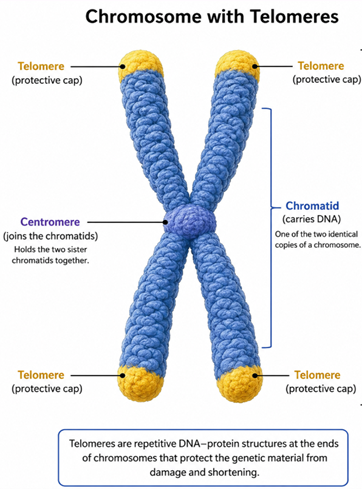
To understand what science says, it helps to know about telomeres. Telomeres are repetitive stretches of DNA found at the end of every chromosome — think of them like the plastic tips on the end of shoelaces that stop them from fraying. They protect our chromosomes from damage when cells divide and multiply. Cells must divide to promote growth, repair damaged tissues and replace worn out cells. However, every time a cell divides, its telomeres get shorter due to a fundamental flaw in how DNA copies itself. An enzyme called telomerase helps preserve and rebuild them. The shorter our telomeres become, the faster we age. Research consistently shows that lifestyle choices directly affect how quickly our telomeres shorten
Up until January 2026, research has always concluded that our genes have only 20 – 30% influence on how long we live and 70 – 80% dependent on lifestyle. Latest 2026 researchers now suggest that genetics may account for about 50–55% of the variation in human lifespan. This has come about as a result of excluding extrinsic factors such as accidents, disease outbreaks and environmental factors that lead to death. This means that genetics and lifestyle are closer to equal partners in biological ageing than older estimates once suggested. Even so, the practical message remains the same: our daily choices still matter greatly. In addition to this, research explains that a healthy gut microbiome (achieved through a healthy lifestyle) can turn bad genes off, increase life expectancy and force genetic influence to drop below the new 50% mark. So the old data is still valid, even though in a different context.
Key lifestyle factors that science has linked to a longer life include:
• Self-control — Better diet choices support your body’s cells, preserve telomeres, and protect healthy hormones and brain chemicals.
• Community and healthy relationships — Strong social bonds and a sense of belonging are linked to better hormonal balance, reduced inflammation, and significantly longer lives. Loneliness, by contrast, is now considered a serious health risk. In fact, the 2023 U.S. Surgeon General’s advisory says that lacking social connection can raise the risk of premature death as much as smoking up to 15 cigarettes a day. It also highlights higher risks of heart disease, stroke, depression, anxiety, and dementia
• Honouring the body through movement — Regular physical activity, including daily movement, is one of the most evidence-backed ways to slow ageing and reduce disease risk. It activates telomerase production (the enzyme that rebuilds telomeres)
• Whole foods and moderation — A diet rich in vegetables, fruits, legumes, and whole grains, eaten in moderate amounts, is consistently linked with longer, healthier lives across cultures. Eating healthily is linked to higher telomerase activity.
• Sleep and rest — Good sleep is one of the most important longevity habits, and regular rest helps the body repair, reset stress, and restore balance. Sabbath rest fits beautifully with this, because it reminds us that human beings are not machines and that rest is part of God’s design.
• Managing stress — Chronic stress accelerates cellular ageing and shortening of telomeres. Research shows that trusting in God and practising faith-based principles such as prayer, gratitude, and resting can meaningfully reduce stress levels.
• Sense of purpose — Having a reason to get up in the morning, related to your calling and stewardship of your gifts, is one of the strongest predictors of longevity found in global ageing research.
• Faith practices — Prayer, worship, and reverence for God have been shown in multiple studies to be associated with longer, healthier lives and greater emotional wellbeing.
• Generosity — Living generously, giving time, care, and resources to others, is both biblically grounded and associated with better wellbeing and healthier ageing.
• A healthy gut microbiome — maintained by the very lifestyle principles Scripture already commends — is one of the biological ways in which bad genes are switched off to extend our lifespan.
The biblical principles are working at a deeper biological level than most people realise.
In Conclusion
God truly is the giver of life. The principles He has laid down — living wisely, righteously, with purpose, rest, generosity, and community — are the very things that science now confirms support healthier ageing. You do not have to choose between faith and good health. They go hand in hand. For the person who walks in faith, lives wisely, and trusts God's promises, the effective influence of genetics on their lifespan is likely to be at the lower end of what science projects — and God's power operates entirely beyond what science can measure.
So back to the question: do we have any real say in how long we live? I would say Longevity is not guaranteed by spirituality alone. God has laid down principles for living wisely and righteously. Our genes have a lot less influence than we think. Science backs God’s laid down principles. If we follow these, we increase our chances greatly in living healthily long. With that said, we are aware that we cannot always predict outcomes in a broken and perverse world. But that should not cause fear. We can daily rely on his divine protection and mercy while following the principles and formula he has laid out for us in his word and which science continues to affirm time and time again. The ultimate great news is that, as a born-again Christian, you do not have life just here on earth but eternal life through Jesus Christ. Our lives go beyond here, on earth.
1 John 5:11-13 (NKJV) "And this is the testimony: that God has given us eternal life, and this life is in His Son. He who has the Son has life; he who does not have the Son of God does not have life. These things I have written to you who believe in the name of the Son of God, that you may know that you have eternal life..."